

FEEDING GUIDELINES
To get an estimate on how much to feed your pet you can use our calculator HERE (please continue till 2nd step of our subscription and click on the 'not sure?' button to check out our the calculator)
Our calculator uses various data to help you get the best estimate we can provide for your cat. Below are the various data that we have used to build our calculator so you are able to get an estimate easily. However, please do note that the information here are recommendations and to be used as a guide. Please consult your vet if there are special dietary requirements or you can reach out to us and we will consult with our in house nutritionist to help you as best as we can!
How much food per day?
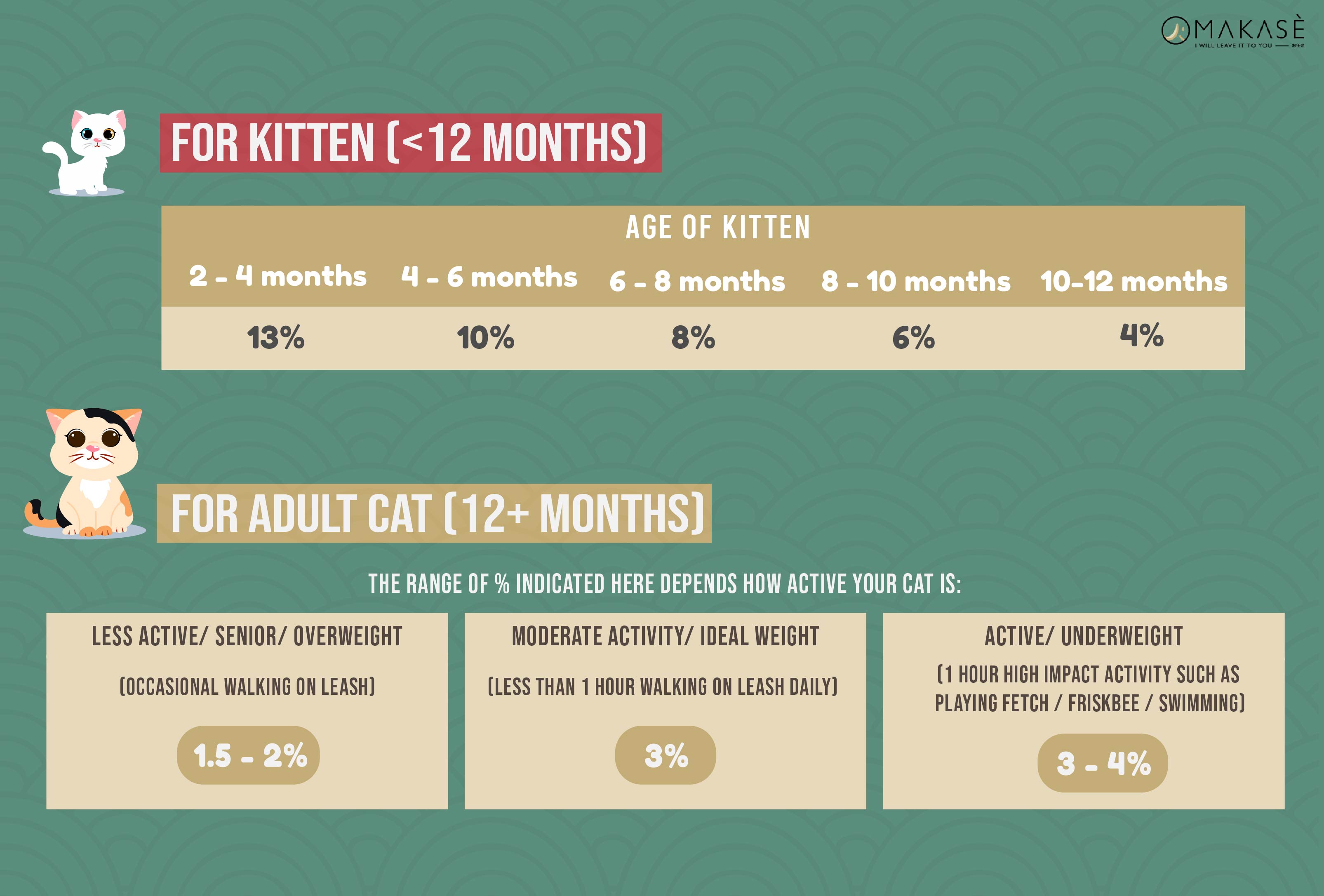
How many meals per day?
If your kitten is less than 6 months it is advisable to feed them more meals a day - approximately 3-4 meals per day
More than 6 months till adulthood feeding 2 meals per day will be ideal.
Is my cat under or overweight?
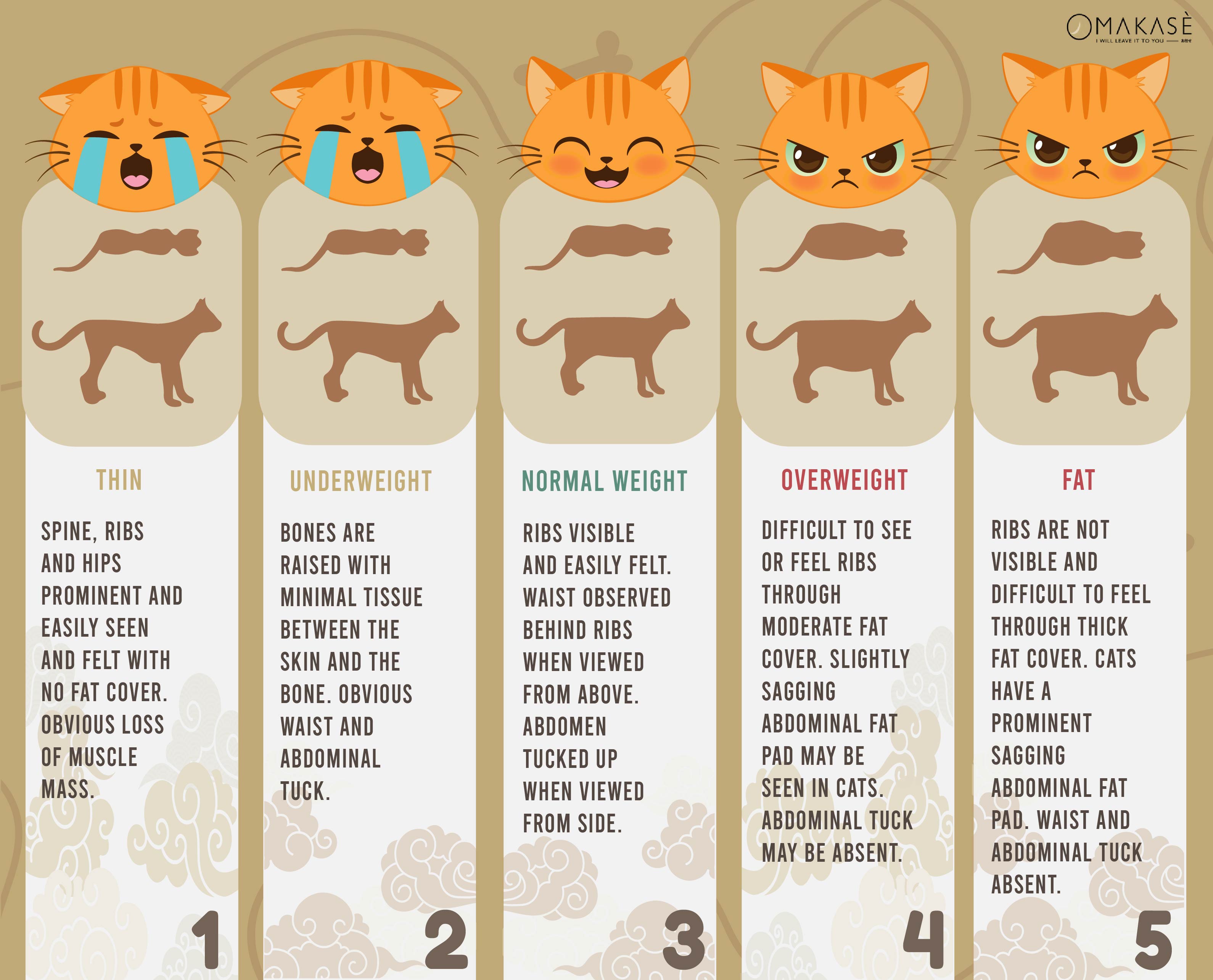
Different cats have different metabolic needs and are all built differently. If you notice your cat is underweight or even thin, as shown in the illustration above, you can adjust to increase the food intake slightly more in the spectrum of the recommended amount. Vice versa, if you realise your cat is getting overweight or even fat, you can reduce the amount accordingly and monitor.
Transitioning from other food
Transitioning cats from kibble / canned food to fresh food can be challenging as cats are picky eaters. However, it is definitely a beneficial step towards providing them with a healthier and longer life with a more natural diet. Here are some tips while transitioning your cat to OMAKASE!
In general transitioning cats is a challenge, and the duration and ease of transitioning depends on quite a number of factors. These factors could allow your cat to transition quicker or slower. The trick is definitely to always monitor and observe and adjust depending on individual cats.
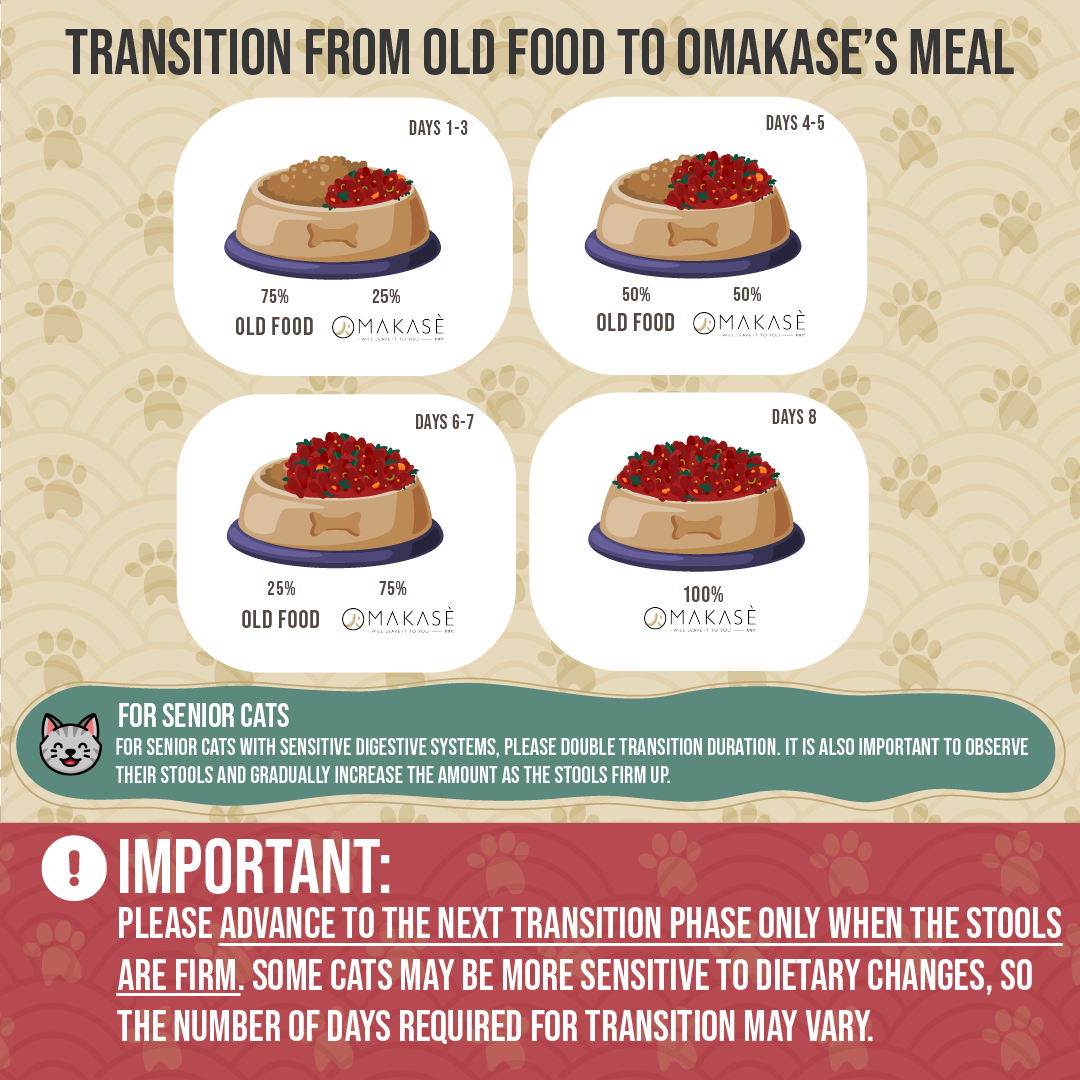
Abruptly switching a cat's diet can cause digestive upset, so it's best to transition gradually. A very general guideline would be to start with 20% of the old food and 80% OMAKASE. Keep at this ratio for at least 1-3 weeks depending if your cat starts trying out OMAKASE already or not. It is fine if they do not eat it at the beginning, just monitor over 1-3 weeks and see if they slowly start to identify and realise that the new addition is also food. When they start trying and eating the food wait for 3-4 days and gradually increase the proportion of OMAKASE fresh food. Increase 20% every 3 days or so as you observe your cat starting to eat more of OMAKASE until you reach 100%. These are some of the different scenarios that could result in differing time span for transition: - If your cat is still a young kitten transition can be much quicker as the have not ingrained the smells and taste a particular food yet. - If your cat is currently on kibbles or canned food, switching to fresh food could take a longer time for your cat to get used to a drastically different diet. - If you are currently already feeding fresh food, it will definitely be much quicker for your cat to adapt and transit to. However, do keep the transition gradual as the composition of different fresh food could still be different and we do not want to cause digestive upset by changing too rapidly.
Try Different Protein Types
Giving different types of protein to your cat to see which they could be more interested in is a good way to encourage them to transit to reduce the resistance of transitioning into a fresh food diet
Raw VS Cooked
Try experimenting with cooked and raw meals as well. If your cat is already currently eating raw or cooked meals, stick to something similar and gradually change if needed. Some cats may prefer raw meals some may prefer cooked meals. Some cat prefers the raw and fresh smell of the meat, while some may prefer OMAKASE’s sous vide cooked meal where all fragrance and flavour is locked within the vacuum sealed bag.
Consistency With the New Diet
Maintaining consistency during a transition process is key. If a protein type is changed or changing from raw to cooked in the middle of a transition, could cause your cat to reject the new food again and result in starvation because of the reluctance in eating the new food. Keep consistent until a transition is completed and stay with the new diet for a couple of weeks before introducing a new variety if desired. Remember, each and every individual cat is unique. Monitoring your cat’s behavior, appetite, and litter box habits during the transition period is key, so you are able to make adjustments to aid with you cat’s transition to a better and longer healthy life!
Storage and feeding
Other than our value trays, Omakase individually packs the food customized specifically to your pets’ needs and for your ease of use. Each individual meal is packed not only for convenience but also hygiene, so you would not have partial used packs.
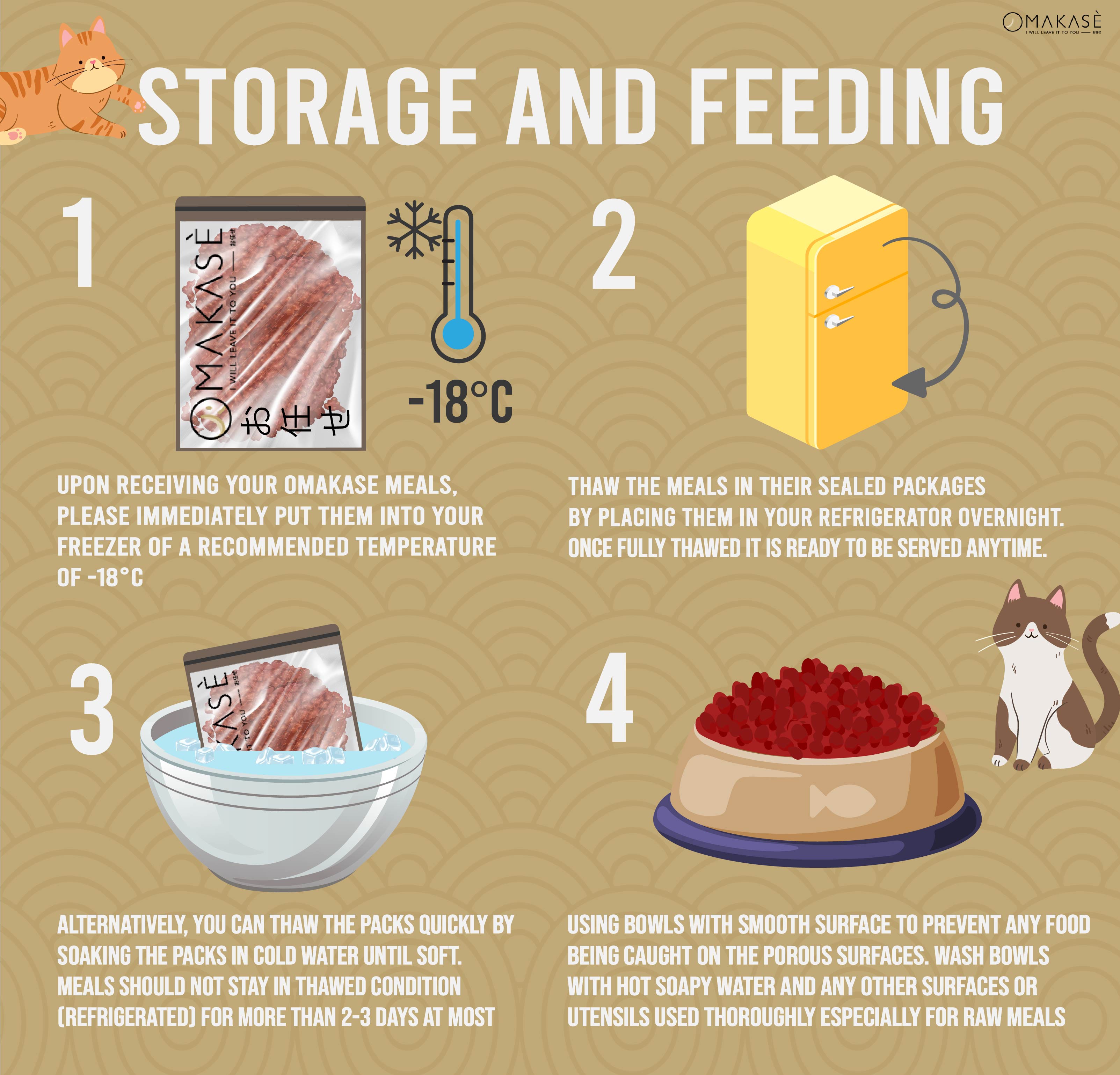
Upon receiving your Omakase meals, please immediately put them into your freezer of a recommended temperature of -18°C as this inhibits the growth of bacteria and shuts down any other microbes, such as yeasts and molds, in the food.
Keep all Omakase meals frozen unless you plan on feeding. You can thaw the meals in their sealed packages by placing them in your refrigerator overnight. Once fully thawed it is ready to be served anytime. Alternatively, you can thaw the packs quickly by soaking the packs in cold water until soft. Meals should not stay in thawed condition (refrigerated) for more than 2-3 days at most.
Once opened, especially for Omakase’s value trays, do not leave it out longer than 20 minutes before feeding or placing them back in the refrigerator. You can either serve it immediately or to let it sit out 5-10 minutes for it to warm up to room temperature, or add before serving.
Consider using bowls with smooth surface to prevent any food being caught on the porous surfaces. Wash bowls with hot soapy water and any other surfaces or utensils used thoroughly especially for raw meals.